Food Waste Champion: Rachael Jackson from Eat or Toss
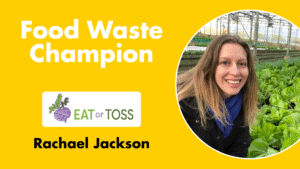
Meet Rachael Jackson, founder of Eat or Toss, and our Food Waste Champion for the month of April.
1. Can you tell us a bit about yourself, your background and what led to the start of Eat or Toss? What was the moment that sparked the idea for Eat or Toss?
Many years ago I signed up to receive a weekly box of produce from a farmer. It was a great experience, but I found that some items didn’t seem quite right. I’m not talking about cutely twisted carrots or bell peppers in funny shapes. Rather I was getting spotty apples, moldy tomatoes and broccoli doubling as a caterpillar apartment. I felt a tension between not wanting to throw them away, but also not wanting to risk getting sick.
I honestly expected a website like EatOrToss to already exist and was surprised by how difficult it was to find complete and trustworthy answers and explanations to my questions. So, I decided to create the resource I wanted! My background is journalism. I spent years as a newspaper reporter and was working for the National Geographic Channel when I started EatOrToss. I was very comfortable tracking down experts and writing articles about these scenarios. I also found that I just loved going deep on how food works–there are fascinating little universes inside our produce and other foods!
2. Can you describe the first food item that made you think, “I need to investigate this”?
I’m not sure what the first item was, but my favorite from those early days was this hollow heart potato. It looks bizarre, but it has a neat explanation and is fine to eat.
3. How do you hope the site changes people’s relationship with food and waste?
My goal is to help people understand their food better so they can waste it less and make safe food decisions. Among other things, when you understand how mold travels through hard and soft foods differently, and what bacteria need to thrive, it becomes easier to assess food that seems iffy.
While the central focus of the site is articles and images relating to specific weird-looking food scenarios, I also hope the site is a hub for reframing our relationship with food and waste. I also feature recipes that use up easy-to-waste items and promote other efforts to reduce waste.
4. What’s your process for researching food safety topics? How do you decide which foods or issues to feature?
The topics that land on the site come from reader images and questions, my own experiences and sometimes research based on what people are searching for that isn’t yet addressed on EatOrToss or on the internet at large. Usually I do an initial research dive on the web, with a focus on academic papers, university websites and other authoritative sources. Then I often reach out to a scientist who works with that food or a related issue to ask more questions and to help connect the dots from my research.
5. How do you ensure the information is both scientifically accurate and easy to understand?
In terms of accuracy, I’m very picky about the sources I reference. And most articles include an interview with a scientist as a source. After I’ve drafted an article, I create a separate document with detailed annotations so I have a record of where each fact came from. Once I post, I share the article with the scientist I interviewed to ensure that their eyes are on the final as well.
In terms of keeping things easy to understand, three things are important to me: 1) an image (because there are lots of ways for an apple, for example, to have “spots”); 2) a quick answer for people in a hurry; and 3) an in-depth explanation for people (like me!) who are extra curious and who aren’t convinced until they’ve heard the explanation behind the guidance.
While the site goes fairly deep on some topics, I’m a generalist and enjoy writing in a lighthearted and casual way. I think that keeps things easy to understand.
6. Have you seen any measurable impact in terms of food waste reduction or behaviour change?
Millions of people have visited the site, so I think that’s something! It’s hard for me to track what happens after they read an article–did they avoid throwing away the item? Did they avoid throwing away every item like that from then on? And, to be fair, in some cases where there is a real food safety issue, I may actually lead people to throw away food that they might have otherwise eaten.
All that said, anecdotally, I frequently hear from readers that it’s helping them. Like one who told me that EatOrToss had saved her “at least a pound of food” and notes like this: “I just stumbled on your site and I am so excited! I feel very strongly about limiting food waste and it is so helpful to have one place to look for guidance rather than searching all over the internet and trying to discern which sites are trustworthy sources. Thank you!”
7. What’s the most surprising or memorable question someone has asked through the site?
This egg. If you have a weak stomach I’m not sure I advise clicking the link. It’s pretty wild!
8. Has running Eat or Toss changed how you shop, cook, or eat?
Absolutely. I love being able to look at a piece of produce and understand exactly what’s happening to it as it ages, and whether those changes are causes for concern or not. Sometimes I just get excited seeing nature at work in my kitchen. My husband is wonderfully patient with the “experiments” I sometimes run.
In terms of cooking and food waste, paying attention to food waste has really highlighted for me how important it is to limit the amount of food we bring into our homes. Skipping the store and working with what you have can save so much waste and money. It’s something I preach, but am still working on myself. I wrote about this for the Washington Post last year.
9. Are there any foods you still struggle to assess?
Vulnerable foods that have been sitting out for a while drive me nuts. That’s when dangerous bacteria can grow and real food safety issues can crop up. In those cases, there aren’t any sensory clues; you just have to know the history of the food.
10. What’s next for Eat or Toss? How do you see the role of consumer education evolving in the fight against food waste?
Consumer education is huge! I’d love to see more energy and investment in educating consumers (shameless plug, please support EatOrToss here). That can be hard because it’s harder to match investment to metrics, but I also think it’s essential to actually move the needle on this issue. If people aren’t wasting at home, they’ll be more likely to notice and hopefully speak up and act when it comes to the waste on display at workplaces, restaurants, stores and beyond. Consumer education has an exponential impact.
11. What’s the weirdest food you’ve ever investigated? And one food you’ll never toss?
Again, with apologies to those with weak stomachs, whenever I write about insects and food, things get extra weird and fascinating fast. Ever noticed those little wispy fluffs on apple stems? Sometimes, that could be a little “sleeping bag” a spider spun for itself. Tiny spiders like those little apple nooks because they provide protection and easy access to bugs.
And, hmm. A food I’d never toss is hard to pinpoint, but one that is heartier than I think people realize is yogurt. It’s naturally acidic, which is great for keeping bad bacteria at bay. Yogurt can last a while. I rarely worry about eating it past its date, though I try not to push it too far. Usually it’ll tell you it’s too far gone when it gets moldy. Otherwise, you might notice quality issues.