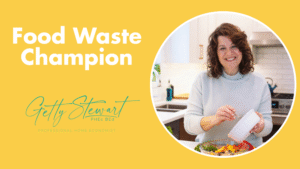
Food Waste Champion: Getty Stewart
Meet Getty Stewart, home economist and our LFHW ambassador, and our Food Waste Champion for the month.
- Tell us a little about yourself. What first sparked your passion for food education and home economics?
I grew up on a farm in Manitoba where nothing went to waste. We had a gigantic garden and eating fresh, seasonal food and preserving what we could was the norm. In high school, I got to shadow professional home economists for a work experience program and loved how they made everyday skills practical and accessible. Shortly after, I moved to the big city to study Human Ecology and Education at the University of Manitoba—setting the foundation for my career in food education. - What led you to launch GettyStewart.com and what was your vision for it?
It started with apples on the curb. While out walking with my kids, we saw bags and bags of perfectly good apples waiting piled next to the trash bin, destined for the landfill. It was a heart wrenching sight, one that led me to start Fruit Share, a volunteer group rescued fruit from people’s back yard to be shared between the homeowner, volunteer pickers and a non profit that could make use of fresh fruit. Over its ten year life span, Fruit Share rescued just under 100,000 lbs of fruit. It also made me aware of how many people did not know how to pick, use or preserve our local fruit. That’s when I started writing, speaking and teaching about local, seasonal food. That’s when I wrote my first book The Prairie Fruit Cookbook and launched GettyStewart.com to share recipes and help people cook, store, and enjoy seasonal food while reducing waste. - How do you define “seasonal cooking,” and why is it important?
Seasonal cooking is simply letting what’s in season guide your meals. Using fresh food grown as close to home as possible naturally inspires variety, tastes better, and connects me to the natural rhythms of my community and ecosystem. It makes me more aware of the people who grow my food, the resources it takes, and the stories behind each harvest. For me, it’s more than what’s on the plate; it’s about staying connected to the land and the people who nourish us. When you have that sense of connection, wasting food just doesn’t make sense. - What role does food waste reduction play in your work and messaging?Food waste reduction is a natural extension of what I do. Knowing the effort and resources that go into growing food makes me want to respect every bite—even the misshapen or “imperfect” ones. My goal is to help people select, store, and savour their food so nothing goes to waste.
- What’s your process for developing recipes and food tips for your audience?
I start with what’s in season and look for approachable ways for home cooks to use or preserve it. I want to create recipes that showcase the best of seasonal produce and make people look forward to that produce every year. - What’s one food myth you love debunking?Careless social media “hacks.” Things like storing avocados in water, freezing peas without blanching, or making garlic oil at home. I love a good shortcut as much as the next guy – but not at the risk of possible food borne illness. I prefer to keep my tips and hacks based on evidence and safe practices.
- Have you had any “aha” moments in the kitchen that changed how you cook?Yes—learning to cook with cast iron. Once I figured out how to properly season and use them, I’ve never looked back – they’re my go to pans and make cooking a joy.
- Are there any new projects, cookbooks, or collaborations in the works?I’m excited to be working with Love Food Hate Waste—it aligns perfectly with my mission. I’m also sharing my new Summer Salad Book and continuing to collaborate with local producers to highlight seasonal Canadian food.
- How do you see the role of home economists evolving in today’s food landscape?
With so much misinformation online, people need trusted, practical advice. Home economists are well-positioned to provide credible, evidence-based food education— we just need to make ourselves easier to find! - Anything else you’d like to share with our audience?
Food connects us—to each other, to the land, and to our communities. My hope is to inspire people to value their food, enjoy it fully, and waste less along the way.