Food Waste Champion: Naomi Hansen
Meet Naomi our Food Waste Champion for the month of November.
1. Can you tell us a bit about yourself, your background as a food writer, and what inspired you to write Building a Sustainable Kitchen?
I’m an author, editor, and speaker based on Treaty 6 territory in Saskatoon, SK. My latest book came out in April and it’s called Building a Sustainable Kitchen: A Practical Guide to Prioritizing the Planet from the Heart of Your Home. This is my second book; my first book came out in 2022, and it’s called Only in Saskatchewan: Recipes & Stories from the Province’s Best-Loved Eateries. I am definitely a foodie and I love to cook, so I have done a lot of food and tourism writing in the past, particularly on Saskatchewan’s food scene. So I am passionate about all things food! Building a Sustainable Kitchen is also very much a book about food, just from a specific sustainability lens.
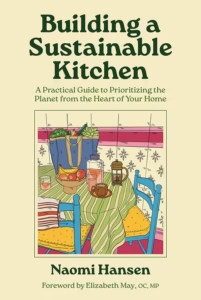
Building a Sustainable Kitchen is a book that goes back to around 2018 for me, when I undertook a project on my personal Instagram account where I tried various sustainable lifestyle initiatives at home, and then reported the results to my small group of family and friends who were on the app at the time. I started this little project because I had been feeling increasingly anxious and preoccupied with the growing impacts of climate change, much of which was accelerated by a particularly bad wildfire season in Saskatchewan in the summer of 2018. And so I was looking for ways to mitigate my own carbon footprint. Initially I sort of jumped on the bandwagon of low waste living. I bought reusable goods like beeswax wrap, cloth produce bags, and stainless steel straws. I started a backyard compost. I was becoming more intense about our garbage and recycling, and what we put in there. Fast-forward through the Covid-19 pandemic and the publication of Only in Saskatchewan.
After that, I knew I wanted to return to the topic of sustainability in my work so I ended up writing more regularly for various publications about lifestyle sustainability topics. I wrote articles about food waste, whether compostable plastics were in fact compostable, what to expect at a zero waste store, and so on. But what I learned from working on these articles was that when it comes to sustainability, there’s a lot more to the story than just recycling or buying reusable kitchen gear — these actions merely scratch the surface of both the depth and reach that individual action can have in addressing climate change. These realizations eventually turned into the idea for Building a Sustainable Kitchen. I wanted to really do a deep dive into exploring food and what we do in the kitchen and how that intersects with climate change.
2. What was the moment when you realized that sustainability in the kitchen was a topic that needed a practical, accessible guide?
The kitchen is the heart of the home; it’s central to everyday life. But many things we do on a daily basis in the kitchen are linked to broader climate problems and solutions. For example: when food waste rots in landfills, it generates methane gas, which is a potent greenhouse gas. We can be a part of the solution here by not throwing food in the garbage. Instead, we can focus on curbing food waste as much as possible at home through how we shop for food, cooking more low-waste, and focusing on using what we have on hand — and then composting anything that’s left to avoid landfill disposal. Another example: daily use of plastics — which are so very pervasive in the kitchen — is tied to plastic pollution. Some of the most common single-use plastics that end up littering beaches and coastal environments around the world are related to food and the kitchen, like plastic straws, food wrappers, and beverage bottles and caps. Overall, the kitchen and food are two key areas where our actions can have a big impact, particularly when considered on a larger collective scale. And that’s not to say that other areas of your home or your life are unimportant. In fact, throughout the book I note many cases where any given solution can be applied beyond your kitchen. But I picked the kitchen and food in particular as a framework for the book, because it’s always useful to have a starting point, and food is so important to our daily lives that I think it makes sense to start there.
3. Food waste is a major theme in your work. Why is it an issue you’re personally passionate about?
Food waste is just such an opportunity for change. There’s the cost to the environment when food is wasted, and then there’s also the cost of the resources that are being wasted in that process, both on the production end but on our own end too, as consumers. Throwing away food is like throwing away money. Then there’s also the potential on a larger scale for food rescue and redistribution, so that more food is being used efficiently and effectively to feed as many people as possible. So I believe that food waste reduction and rescue are just such powerful solutions on so many levels. It’s something I focus on a lot because it also feels like such a natural starting point for talking about climate change. Many people already know that wasting food isn’t good — this is something people can usually agree on. So talking about food waste is an easy and effective way to address wider issues of climate change and demonstrate how individual actions do matter and can make a tangible difference.
4. Tell us about Building a Sustainable Kitchen. How does the book help people reduce food waste and make more sustainable choices in their everyday lives?
Building a Sustainable Kitchen details my own journey to making my kitchen more sustainable and climate-conscious. It covers a range of topics. It starts with chapters that really dive into food — food waste, low waste cooking (which is directly related to food waste!), the impacts of what we eat, local, seasonal, organic food and then alternative methods of grocery shopping. From there it moves into chapters on the theme of waste, such as composting, recycling, garbage, disposable and reusable goods, and plastics. The last part of the book tackles topics that touch on other aspects of food and kitchens, like gardening, cleaning, water, and appliances, for example. And then lastly I look at what you can do beyond the kitchen, which is the concluding chapter.
Overall, it is a deeply researched book that combines the research aspects of each topic with narrative that details my own experiences implementing the solutions provided throughout. So each chapter includes background information on the “why,” which dives into the environmental issues and impacts associated with the topic. Then from there, each chapter has a “What You Can Do” section that moves through various solutions. Most chapters have multiple solutions that you could implement — like food waste, for example. There are numerous solutions in the Food Waste chapter because reducing food waste can look different in practice for everyone.
The key throughout all the chapters however is that I have provided solutions that are realistic, practical, and affordable, taking into account differences based on where readers live. I wanted the book to be genuinely usable and accessible. The book also has a distinctly Canadian focus as well, with Canadian information, stats, and more provided whenever possible. It’s my hope that readers come away with a much better understanding of the why and the how of putting sustainability on their own dinner table — so to speak — and then from there, that they can use that knowledge to make changes in their own home that have a real impact.
5. Through your research and conversations with experts, what have you found are some of the most effective actions individuals can take to reduce food waste at home?
The first thing I would recommend is to conduct a weekly food waste experiment. To do this, pick a day — usually when you’re almost out of food and you need to go grocery shopping — and go through your fridge, freezer, and pantry. Pile everything that is avoidable food waste onto your kitchen counter or table. What you’re piling up is really the things you would throw out, if you were going to clean out your fridge and freezer at that exact moment. From there, take an estimate of the dollar amount of what needs to be thrown away. You can multiply that number by four to get a sense of the monthly amount and then multiply that to get a sense of the yearly amount too. Doing this helps with a visual representation of the food you’re wasting, but also gives you a concrete number of the dollar value that’s being wasted. The other reason this experiment is helpful is because you get a sense of the different types of foods that are potential problem spots. In Canada, the most commonly wasted foods are vegetables, then fruit, then leftovers, followed by bakery items and dairy/eggs. When you do this experiment maybe you notice bread products are a particular problem, or vegetables are a problem, whatever it is. But it helps you have a visual of what’s going on.
From there, I recommend finding a way that works for you to keep regular tabs on the food in your fridge, freezer, and pantry. Often, we don’t actually know or remember what we have already in those three spots, and then we go to the store, we buy more food, we add it to the freezer, or wherever, and maybe we eat it, but maybe we forget about it, or it sits too long, etc. Keeping track can take on a number of forms in practice. This is what I do: for anything in my freezer, pantry, and the stuff in the fridge that is going to be there longer than one or two weeks — condiments, spreads, whatever — I create something that I refer to as an “inventory list.” So every four to six months, I do a full inventory of my pantry, freezer, and the items in my fridge that I don’t buy regularly. I go through everything and write a list for myself of the food I have in each place that needs to be used up within the coming weeks or months. Then I put this list on the fridge and refer to it regularly. Before I buy more food, I check the list. Not sure what to have for dinner? I check the list. It’s a helpful reference and it saves both time and food. You don’t have to do this inventory list practice specifically, this is just a useful system I’ve developed over the years that is most helpful for me. But the key point overall is that you have to be intentional about checking your fridge, freezer, and pantry at regular intervals. A lot of this is really about mindfulness though. When you have a better idea of the food you already have, it’s easier to keep track and stay on top of things, and ultimately waste less food.
6. You sifted through a tremendous amount of information, research, and competing sustainability advice while writing the book. What were some of the biggest challenges, and perhaps opportunities, that came out of that process?
I think the biggest challenge from the research was that some of the findings did not necessarily align with popular information about sustainability at home. For example, if I asked you to provide some examples of sustainable actions in the kitchen, what would you say? Common answers might include recycling as a main focus, buying a lot of reusable kitchen gear like stainless steel straws, buying local meat in your own reusable container, or shopping for food exclusively at farmers’ markets and zero waste stores. Those are all prevailing narratives about lifestyle sustainability in the kitchen at home. None of which are inherently wrong necessarily, but there’s just a lot more going on there than these sorts of black and white assumptions about what is good or bad. Furthermore, there are some key actions missing from that list that should definitely be on there — like eating more plant-based foods, reducing food waste, and reducing energy and water use, for example. So the challenge for me was presenting all of this information in a way that wasn’t going to be totally overwhelming or confusing, and making sure I highlighted the actions that do come out on top as the big impact ones, like food waste reduction, for example.
7. Many people feel overwhelmed by sustainability or unsure where to start. What are your key takeaways to help people get started?
Overall, I do think the best place to start is with something that seems manageable or that you’re interested in. Maybe that’s plastics, maybe it’s food waste. That will look different for every person. If you are reading Building a Sustainable Kitchen though as a starting point, the book is definitely meant to be read in order, cover to cover. The chapters build on each other, so if you pick it up in the middle with Chapter 7 on Recycling, for example, you’ll be missing some background information that I’ve built up to throughout the previous chapters that gets us to that point. So that’s one thing, but the other thing is that it’s meant to be a well-used guide. I want readers to write in the margins, fold down corners, and treat it like a reference, so that you can come back to it again and again. Maybe you read through the whole book and then go back and implement things, or maybe you implement changes as you go along. Either is fine! But you do need to have a bit of a sense of personal sustainability in working through the solutions, which is why picking something that you’re interested in or that seems like a manageable first step is key. The solutions in the book are not meant to be implemented in a span of a few days or even weeks, which is true more generally of any sustainable change you make. You want to actually be able to make changes you can commit to in the long run, so start with something that makes the most sense personally and then go from there.
8. What has been your key success factor in inspiring people to take action on food waste without feeling guilty or overwhelmed?
The book’s key message is really that taking part in the conversation around sustainability and implementing actions at home and beyond is for everyone. This is true whether you are reducing food waste at home, or whether you are getting involved in climate solutions on a local level. The reality is that everyone can play a part here and you don’t need to be an expert in sustainability to be a part of this conversation. Everyone is welcome here.
The other key factor is that I just don’t think that presenting solutions in an all-or-nothing lens is helpful. What’s more helpful long-term: if 20 people reduce food waste perfectly for a few years, or if 1000 people cut their food waste by even half, but on a long-term basis? The second option! And I think that approach is applicable to really any topic in the book. Perfection is just not the goal. If it was, it would be very tough for anyone — myself included — to achieve that. So I always aim to present sustainable actions as A) something that anyone can be a part of, and B) something that does not need to be perfect to make a difference. At the end of the day, solutions like food waste reduction are always going to be most effective when implemented collectively anyway.
9. What’s one lesson you’ve learned as an advocate and educator in the food sustainability space?
There are two things actually! One is that many people want to be involved in this conversation and make changes at home — they might just not be sure where to start or how to get involved. I hope that Building a Sustainable Kitchen can be a genuine antidote to that and give people both a starting point and a plan of action long-term. The second thing is the power of numbers. It’s sometimes easy to feel like our actions don’t matter. But that’s just not true. I’m not just saying that either: a tangible example is from Project Drawdown, which is a non-profit organization that works on science-based climate solutions. On their list of nearly 100 climate solutions, they note that one-third of those solutions can be best addressed by individuals and households specifically. One-third is a lot. It’s a lot more than people maybe even realize. These actions are everyday things, like reducing food waste, composting, and eating more plant foods, for example. So there’s power in those numbers that I think puts things into perspective on just how much of a difference individuals can genuinely have.
10. Is there one simple change our audience could make this week that would have a meaningful impact on reducing food waste at home?
Label and date everything you put into your freezer! A freezer filled with jars, containers, or bags of unlabelled food means that the food is unlikely to be eaten later on, particularly if you’re unsure how old it is. I love freezing food as a solution to preventing food waste overall, and with fall just around the corner I am getting back into making large batches of soups using seasonal produce. Much of that will go into my freezer for quick meals later on. But labeling is such a simple and important action to make sure you actually use the prepared food at a later date.
11. What else would you like to share with our audience?
I want to highlight the Resources List for Building a Sustainable Kitchen, which is a multi-page document that acts as a supplementary source to the book. It’s available on my website for readers in a digital format and it’s organized by chapter, so you can easily find sources that correspond to each chapter as you’re reading. Throughout the book there are many places where I note to check with the Resources List for additional tips, information, and useful tools, many of which I used myself in my own kitchen throughout the process. The Resources List also has additional sources noted for readers who are interested in certain topics, beyond the information I have included in the book.
You can find it here: https://www.naomihansen.ca/buildingasustainablekitchen/resourceslist